

The Vaccine Intelligence Report—brought to you by Vaccinate Your Family—provides clear, fact-based updates on vaccine policy, research, and public health each week. This report is part of Viral Truths, a resource designed to cut through the noise, offering concise information to help navigate the evolving immunization landscape.
THIS WEEK AT A GLANCE:
- New CDC Director Dr. Erica Schwartz takes office as the Administration considers how to implement President Trump’s vaccine Executive Order, with existing CDC childhood immunization recommendations remaining in place for now
- HHS is seeking nominees for the NVAC after revising its charter to expand the committee’s focus on non-immunization strategies and shift membership criteria
- Several states said their childhood immunization requirements will not change following the vaccine Executive Order, reflecting continued reliance on state health departments and major medical organizations as federal guidance changes
- New CDC data show kindergarten vaccination coverage declined again during the 2025-2026 school year, while exemptions from required school vaccinations increased to 4.2%
- The U.S. has reported more than 2,600 measles cases this year as several states report new or growing outbreaks; Covid cases are also ticking up nationwide
- The Bundibugyo ebola virus outbreak in the DRC has become the deadliest in the country’s history as deaths exceed 2,300; outbreak response is complicated by undetected transmission, overburdened surveillance teams, and the lack of an approved vaccine or treatment for the strain
- New research highlights the effectiveness of flu and Covid vaccination in preventing severe illness, hospitalizations, emergency care visits, and deaths
NEED TO KNOW
New CDC Director Faces Early Test Over Vaccine Executive Order
- Erica Schwartz was sworn in as Director of the Centers for Disease Control and Prevention (CDC) last week (Aug. 12), taking over the agency just days after President Donald Trump issued an Executive Order directing further changes to federal childhood vaccine policy.
- The Executive Order itself does not automatically change the CDC’s recommended childhood immunization schedule, putting Schwartz at the center of what happens next. Traditionally, changes to federal vaccine recommendations are developed through the Advisory Committee on Immunization Practices (ACIP) and adopted by the CDC Director before becoming official policy.
- Moving forward with the Executive Order’s recommendations without the traditional ACIP process would mark a significant departure from that system and would likely face legal challenges. Earlier Administration efforts to change the childhood schedule and restructure ACIP are already the subject of ongoing lawsuits brought by the American Academy of Pediatrics (AAP) and co-plaintiffs and a coalition of states.
- During her confirmation hearing, Schwartz repeatedly pledged to follow scientific evidence and faced bipartisan questions about whether she would resist political pressure over vaccine policy, making implementation of the order an early test of her leadership.
- International health officials have also joined U.S. medical organizations in criticizing the order. World Health Organization (WHO) Director-General Dr. Tedros Adhanom Ghebreyesus said that separating or unnecessarily delaying vaccines does not make vaccination safer and can leave children unprotected. WHO officials also warned that requiring more injections and medical visits could reduce vaccination uptake.
- Senator Dr. Bill Cassidy (R-LA), Chair of the Senate Health, Education, Labor and Pensions (HELP) Committee, intensified his criticism of the order over the weekend, arguing that separating the measles, mumps, rubella (MMR) vaccine would increase costs and medical visits while making it less likely that children receive complete protection. Cassidy also reiterated that there is no evidence that vaccines cause autism.
- Practical barriers could also limit implementation of some provisions. Separate measles, mumps, and rubella vaccines are not currently licensed in the U.S., and manufacturers would need to develop new products, secure regulatory approval, and potentially expand manufacturing capacity before they could be made broadly available—a process expected to take years.
- See this week’s Reality Check below for a Q&A on the MMR vaccine.
- For now, existing CDC immunization recommendations remain in place, and the AAP and other major medical organizations continue to recommend evidence-based childhood vaccination, which includes the MMR vaccine.
HHS Seeks Nominees for NVAC After Revising Vaccine Advisory Committee Charter
- The Department of Health and Human Services (HHS) is seeking nominees for the National Vaccine Advisory Committee (NVAC), following recent revisions to the committee’s charter.
- NVAC advises HHS on federal vaccine policy, including vaccine safety, efficacy, availability, and coordination across government and non-government partners. Members may serve terms of up to four years.
- The revised charter expanded NVAC’s scope to consider “non-immunization strategies” for people who cannot or choose not to be vaccinated and shifted membership criteria toward more public members and fewer academic or industry-funded vaccine researchers.
- According to the Federal Register notice, membership will include “a selection of public members who are engaged in gold standard science, vaccine safety or efficacy research, or who are physicians, scientists, members of parent organizations concerned with immunizations, representatives of state or local health agencies or public health organizations.”
- Nominations must be received no later than 30 days from the notice’s publication (Aug. 12).
- The effort to rebuild NVAC comes as the Administration advances a broader review of vaccine policy. The recent order directs the HHS Task Force on Safer Childhood Vaccines to report within 90 days on:
- Options for shifting vaccines, including MMR, from combination to individual vaccines;
- The timing of vaccines on the childhood immunization schedule;
- Alternatives to aluminum adjuvants; and
- Expanded vaccine safety monitoring and research.
- Together, the developments indicate that HHS is moving forward with changes both to the outside advisory structure informing vaccine policy and to the policy questions those bodies may be asked to consider.
STATE POLICY ROUNDUP
States Maintain Childhood Immunization Policies Following Executive Order
- Several states across the country have said that their immunization requirements will not change following Trump’s recent Executive Order calling for revisions to the childhood immunization schedule.
- States—not the federal government—retain the authority to set and enforce immunization requirements, meaning the order itself does not change existing state requirements.
- California said “nothing is changing” under the order, including its childhood immunization recommendations, school requirements, and vaccine coverage policies. The West Coast Health Alliance, comprising California, Hawaii, Oregon, and Washington, similarly reaffirmed its commitment to following the childhood schedule recommended by the AAP.
- Illinois, Michigan, New Mexico, New York, Pennsylvania, Virginia, and Wisconsin similarly stated that they will not change childhood immunization guidelines following the order and will instead continue to follow AAP guidance.
- Texas, which still relies on CDC/ACIP guidance, has stated that existing state immunization guidelines remain in place for the 2026 school year.
- The responses reflect a broader trend toward states relying on their own health departments and leading medical organizations for immunization policy as federal guidance continues to change. No state has yet announced that it will adopt the Executive Order’s proposed changes.
CDC Releases Updated Data on School Vaccination and Exemptions
- CDC findings released Monday (Aug. 17) show that during the 2025-2026 school year, vaccination coverage among U.S. kindergartners decreased for all reported vaccines from the year before, continuing a multiyear erosion in childhood vaccination coverage rates (VCRs).
- National coverage for the MMR and polio vaccines fell to approximately 92.4%, while diphtheria, tetanus, and pertussis (DTaP) coverage fell to 92.0%.
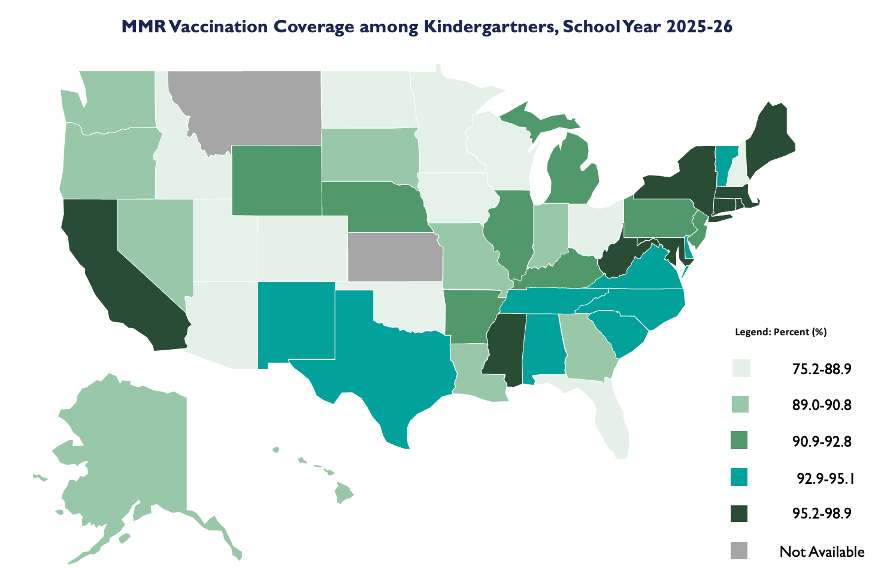
- MMR coverage remains below the approximately 95% level needed to reliably prevent sustained measles transmission and varies substantially by state, ranging from 98.9% in West Virginia to 75.2% in Idaho. See the map below for state-by-state MMR vaccination rates.
- At the same time, exemptions from one or more required kindergarten vaccinations increased to 4.2% from 3.6% the year before.
- Exemptions increased in 41 states and D.C., with 24 states reporting exemptions greater than 5%.
- The findings come as the U.S. continues to experience record-breaking measles activity and as the Administration pursues additional changes to federal childhood vaccine policy that could further impact VCRs.
Source: CDC
OUTBREAK OUTLOOK
States Report New Measles Outbreaks as U.S. Sees Summer Uptick in Covid Cases
- As of August 14, the U.S. has reported 2,632 measles cases in 2026—an increase of 148 cases since last week.
- Several states have reported new or continued measles activity in the last week:
- Delaware’s measles outbreak has grown to 22 total cases as of August 17—an increase of 2 cases from last week’s newsletter.
- Iowa officials reported a measles outbreak on Monday (Aug. 17), with 12 cases tied to the outbreak so far.
- Kentucky officials also announced a measles outbreak on Monday (Aug. 17), with 19 cases and 2 hospitalizations so far this year. All cases are among individuals who are unvaccinated or whose vaccination status is unknown.
- Maryland has confirmed 17 cases of measles as of August 13.
- Ohio has recorded 79 measles cases as of August 18.
- Oregon has reported 45 measles cases this year as of August 12.
- Pennsylvania’s outbreak continues to grow rapidly, reaching 307 cases as of August 17—an increase of 60 cases in the last 7 days. Hospitalizations have risen to 53.
- Wisconsin officials reported a fast-growing measles outbreak last week, which has grown to 36 confirmed cases and three probable cases as of August 18.
- The most recent CDC data show that Covid infections are growing or likely growing across all 50 states.
- While cases and hospitalizations remain low, older adults, infants, and people who are immunocompromised are at higher risk of severe illness from Covid.
- Leading medical organizations, including the American Academy of Family Physicians (AAFP) and AAP, recommend that everyone 6 months and older receive an updated vaccine annually for the best protection against severe illness. The CDC hasn’t issued updated recommendations for the vaccines due to ongoing litigation.
Ongoing Ebola Outbreak Becomes Deadliest in DRC History
- The Bundibugyo ebola virus outbreak in the Democratic Republic of the Congo (DRC) has become the deadliest in the country’s history, surpassing the death toll of its 2018-2020 outbreak.
- Through August 16, there have been 5,021 confirmed cases and 2,378 deaths—a death rate of 47%. These totals include 76 cases and 53 deaths since the previous day.
- It took over 10 months for the DRC’s 2018-2020 outbreak to reach 2,000 cases, while the current outbreak reached that mark in just two months.
- Officials note that factors including overburdened surveillance teams, undetected transmission, and the lack of an approved vaccine or treatment for the Bundibugyo strain are contributing to continued levels of spread.
Research Highlights Flu and Covid Vaccine Effectiveness in Preventing Serious Disease
- The 2024-2025 influenza (flu) season was the most severe flu season since 2017, but new data from a CDC-led study shows that flu vaccination reduced rates of hospitalization and emergency department or urgent care visits.
- The vaccine was 51% effective against hospitalization for children and 43% for adults. It was 54% effective against outpatient visits in children, and 49% for adults.
- Separately, a new modeling study suggests that Covid vaccination may have prevented more than 16,000 hospitalizations and 4,000 deaths in a Washington county during the first eight months of vaccine rollout.
- In the study, older adults experienced the greatest protection from vaccination, accounting for half of all averted hospitalizations and nearly three-quarters of prevented deaths.
REALITY CHECK: MMR Vaccine Q&A
Do other countries break up the MMR vaccine?
- Almost all countries use a combined MMR vaccine. At an August 2026 briefing, a WHO official said that only 15 of WHO’s 194 Member States vaccinate against measles, mumps, and rubella using separate, or monovalent, shots; the remainder use a combined MMR vaccine.
- Countries’ immunization schedules vary based on factors such as which vaccines are included in national programs, vaccine availability, and local public health priorities. Some countries, for example, do not routinely vaccinate against mumps and therefore use measles-rubella (MR) or measles-only vaccines rather than MMR. This does not reflect evidence that administering the vaccines separately is safer.
- Japan has historically been a notable exception among high-income countries. It stopped using the MMR vaccine in its national immunization program in 1993 after reports of meningitis—the inflammation of the area surrounding the brain and spinal cord—linked to the Urabe strain of the mumps vaccine used in Japan at the time.
- Importantly, American MMR vaccines have never used the Urabe strain, instead using the Jeryl Lynn strain of mumps.
- After withdrawing MMR, Japan switched to separate measles and rubella vaccines and removed mumps vaccination from the routine immunization schedule. Mumps vaccination became voluntary, and coverage remains low.
- Mumps remains a major disease burden in Japan, with up to 5 million patients infected annually. The disease is a major cause of hearing loss in the country and accounts for up to 25% of pediatric single-sided deafness.
- Japan also struggled with inadequate measles vaccination coverage after breaking up the MMR vaccine. In 2001, the country experienced a major measles epidemic that caused an estimated 265,000 cases among children under age 15. Another large outbreak in 2007 prompted a five-year national catch-up campaign to increase vaccination.
- Importantly, Japan does not recommend giving all three vaccines separately. Since 2006, its national program has used a combined MR vaccine, while mumps vaccination has remained voluntary.
- Japan has also recently taken a step toward making a combined MMR vaccination available again. In May 2026, the country approved its first MMR vaccine in more than three decades.
- Overall, international practice strongly favors combination vaccination. Even Japan—the country most often cited as an exception—has used combined MR vaccination for two decades and is now preparing to reintroduce a combined MMR vaccine.
Is it safer for children to receive the measles, mumps, and rubella vaccines separately?
- There is no evidence that separating the three vaccines makes vaccination safer. The combined MMR vaccine has been extensively studied and monitored for decades, and major medical organizations continue to recommend it as safe and effective.
- Combining the three vaccines does not place greater strain on a child’s immune system or create additional safety concerns. Experts underscore that there is no scientific or immunologic benefit to administering them separately.
- Claims that separating MMR could reduce autism are particularly unsupported. Numerous large studies conducted across multiple countries have consistently found no association between MMR vaccination and autism, and Japan provides a useful real-world example of what happened when MMR vaccination stopped.
- Researchers examined autism diagnoses among children born in Yokohama, Japan, during the period spanning the country’s withdrawal of MMR vaccination. Autism diagnoses continued to increase even as vaccination decreased—and rose most sharply among children born after MMR vaccination had stopped entirely.
- Researchers concluded that eliminating MMR vaccination could not be expected to reduce autism incidence. In other words, Japan effectively provided a natural experiment demonstrating that removing the combined vaccine did not reverse rising autism diagnoses.
- Separating the vaccines could instead introduce new risks by making it harder for children to become fully protected. A combined MMR vaccine protects against all three diseases with one injection; separating it would require three injections and, under the recent Executive Order, potentially three separate medical appointments.
- Combination vaccines were developed in part to reduce the number of injections and medical visits required. Evidence shows that children who receive combination vaccines are more likely to complete vaccination and receive recommended doses on time.
- The WHO similarly identifies improved vaccination timeliness, greater acceptability, and higher and more equitable vaccination coverage as key benefits of combination vaccines.
- Experts have warned that this added complexity is especially concerning as U.S. childhood vaccination rates continue to decline and measles cases remain at their highest levels in decades.
- Breaking up MMR offers no demonstrated safety benefit and could make it harder for children to receive complete, timely protection against all three diseases.
What would it take for the U.S. to replace MMR with separate vaccines?
- Separate measles, mumps, and rubella vaccines are not currently available in the U.S. In 2009, Merck announced it would no longer manufacture its monovalent vaccines after pausing production in 2008, given manufacturing constraints and the lack of evidence supporting separate vaccine administration.
- Replacing MMR with separate vaccines would therefore require manufacturers to develop and produce new products—and federal policy alone cannot make that happen.
- Manufacturers would need to determine that producing three separate vaccines is scientifically and commercially feasible.
- Each product would then need to go through the necessary testing, Food and Drug Administration (FDA) review and approval, and manufacturing scale-up before it could be widely distributed.
- This would likely take years, not months. Vaccine manufacturers and regulatory experts have said that even with expedited pathways, developing, approving, and producing separate vaccines at national scale could take several years and potentially up to a decade.
- Manufacturing capacity would also be a major challenge. Replacing one combined vaccine with three separate products would require substantially more vials, filling operations, storage, distribution, and inventory management across the healthcare system.
- Even if separate vaccines were eventually approved and available, the U.S. would still need to determine how they would be incorporated into federal immunization recommendations, insurance and Vaccines for Children (VFC) coverage, purchasing systems, and provider workflows.
- In short, replacing MMR with separate vaccines would require new products, regulatory approval, expanded manufacturing capacity, and broad changes across the healthcare system—making it a complex, years-long process rather than an immediate policy shift.
WHAT TO WATCH
Trump Expected to Nominate White House Official Heidi Overton to Lead FDA
- Trump is expected to nominate Heidi Overton, Deputy Director of the White House Domestic Policy Council (DPC), to serve as the next Commissioner of the FDA.
- Overton has helped shape health policy within the White House and was present when Trump signed his recent Executive Order directing changes to childhood vaccine policy.
- Previously, Overton was Chief Policy Officer for the America First Policy Institute and led its Center for a Healthy America. She trained under former FDA Commissioner Dr. Marty Makary at Johns Hopkins.
- If formally nominated, Overton will require Senate confirmation. Her nomination could face scrutiny before the Senate HELP Committee led by Cassidy, who has repeatedly pressed Administration health nominees on vaccine safety and evidence-based policymaking.
- Her selection comes as the agency continues to navigate leadership turnover and heightened scrutiny over its approach to vaccines and other medical products.
HHS Regulatory Agenda Highlights Vaccine Safety and Efficacy as Priority
- HHS released its 2026 regulatory agenda last week (Aug. 14), explicitly outlining “ensuring the safety and efficacy of our vaccines” as one of the department’s overarching regulatory priorities.
- Outside of this high-level mention, the agenda provides no additional details about specific vaccine-related policies or regulations HHS plans to pursue, leaving open how the priority will translate into future rulemaking or policy.
- More broadly, the inclusion of this language in the agenda comes as the Administration continues to take steps to reshape federal vaccine recommendation, advisory processes, and regulatory policy.
###
Vaccinate Your Family is a nonpartisan organization dedicated to protecting people of all ages from vaccine-preventable diseases. To learn more visit us at: vaccinateyourfamily.org
If additional members of your team would benefit from receiving this newsletter, please reply to this email with their information so they can be added to the newsletter distribution list