

The Vaccine Intelligence Report—brought to you by Vaccinate Your Family—provides clear, fact-based updates on vaccine policy, research, and public health each week. This report is part of Viral Truths, a resource designed to cut through the noise, offering concise information to help navigate the evolving immunization landscape.
THIS WEEK AT A GLANCE:
- The Trump Administration issued a new Executive Order directing further changes to childhood vaccine policy, including fewer vaccines routinely recommended for all children, greater use of shared clinical decision-making, and a push to separate combination vaccines and increase the number of medical visits for vaccination
- Medical and public health organizations strongly opposed the Executive Order, arguing that the changes are not supported by new evidence and could create additional barriers to vaccination
- The Senate confirmed Dr. Erica Schwartz as CDC Director, putting her at the center of implementing federal vaccine policy as the Administration moves to further reshape the childhood immunization schedule
- The FDA approved Moderna’s mFlusiva, the first mRNA flu vaccine in the U.S., for adults ages 50 and older, while the AAP separately reaffirmed annual flu vaccination for all children ages 6 months and older
- U.S. measles cases climbed to nearly 2,500, driven in part by a rapidly growing outbreak in Pennsylvania; PAHO has warned that measles is spreading faster across the Americas, and the U.S. faces a review of its measles elimination status
- The Bundibugyo Ebola outbreak in the DRC continues to expand at a record pace, while researchers explore whether an existing Ebola vaccine could provide cross-protection against the virus
NEED TO KNOW
Trump Administration Moves to Further Reshape Childhood Vaccine Policy
- President Donald Trump signed an Executive Order on Monday (Aug. 10) establishing new “Gold Standard Childhood Vaccine Recommendations” and directing federal agencies to take additional steps to reshape childhood immunization policy.
-
- The action builds on earlier Administration efforts to reduce the number of vaccines routinely recommended for all children, implementation of which has been complicated by ongoing litigation.
- Under the new framework, vaccines against 11 diseases would remain recommended for all children—compared to 17 diseases under the Centers for Disease Control and Prevention’s (CDC) July 2025 recommended childhood immunization schedule and 18 diseases recommended by the American Academy of Pediatrics (AAP).
- Other vaccines would be recommended only for certain high-risk groups or based on shared clinical decision-making (SCDM). See the graphic below for a full comparison of the CDC, AAP, and Executive Order schedules.
- Extensive evidence supports the safety and effectiveness of the vaccines included in the longstanding childhood immunization schedule, and medical organizations have said there is no new evidence supporting the reductions in routine recommendations.
- Despite the changes in recommendation categories, the order is not expected to immediately affect vaccine coverage. Childhood vaccines that remain on the CDC schedule—including those recommended through SCDM—are expected to continue to be covered without cost-sharing by private insurance and through the Vaccines for Children (VFC) program.
- The order goes further than previous changes by calling for the combined measles, mumps, and rubella (MMR) vaccine to eventually be replaced with three separate vaccines once single-disease products become available in the U.S. It also says childhood vaccines should, “to the maximum extent feasible,” be administered at separate medical visits.
- Medical experts have raised concerns about separating vaccines across additional visits. Longstanding immunization guidance has emphasized administering recommended vaccines during the same visit because doing so increases the likelihood that children receive vaccines on time and reduces missed opportunities for protection.
- Critically, separate measles, mumps, and rubella vaccines are not currently available in the U.S., meaning the change could not be implemented immediately. Developing and licensing new single-disease vaccines would require clinical testing, Food and Drug Administration (FDA) review, and manufacturing changes—a process experts have said could take years.
- The order also seeks to increase federal influence over state immunization policy, encouraging states to reconsider school immunization requirements and directing the Department of Justice (DOJ) to support certain legal challenges involving parental authority, religious freedom, medical accommodations, and exemptions.
- States ultimately set school immunization requirements, and many states have already moved away from recent federal vaccine guidance, instead relying on AAP and other independent medical organizations or developing their own recommendations.
- The order directs the Department of Health and Human Services (HHS) Task Force on Safer Childhood Vaccines to develop plans within 90 days to reassess vaccine timing and sequencing, expand access to single-antigen vaccines beginning with MMR, study alternatives to aluminum-containing adjuvants, and expand vaccine safety monitoring and research.
- Typically, changes to the federal immunization schedule are recommended by the Advisory Committee on Immunization Practices (ACIP) and adopted by the CDC Director before becoming official HHS policy. The Executive Order could test that process just days after the Senate confirmed Erica Schwartz as CDC Director.
- See below for more on Schwartz’s confirmation and the role she could play in implementing future vaccine policy.
Comparison of Immunization Schedules: AAP, CDC, and Executive Order
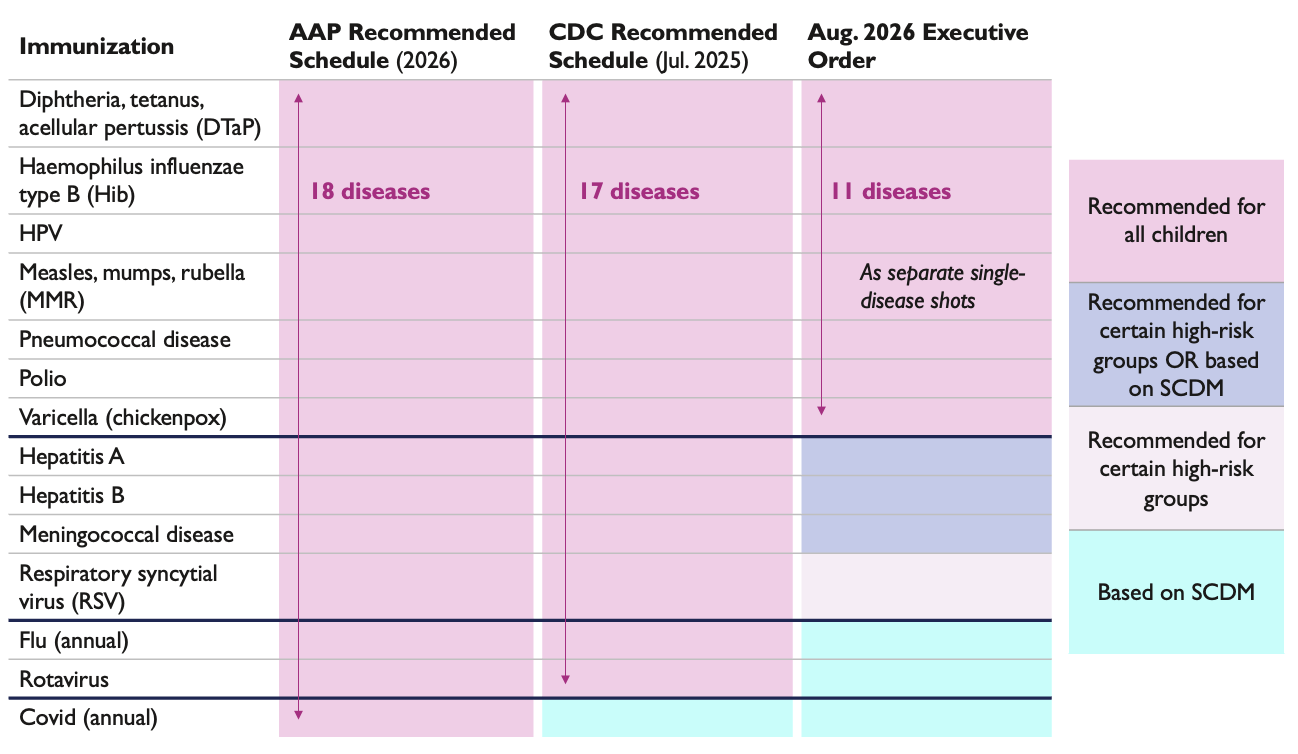
Sources: AAP, CDC, White House
Medical and Public Health Groups Push Back on Executive Order
- The Executive Order drew immediate opposition from medical, infectious disease, and public health organizations, which largely argued that the changes are not supported by new evidence and could make vaccination more difficult.
- Major medical organizations—including the AAP, American Academy of Physician Associates (AAPA), American College of Physicians (ACP), and American Medical Association (AMA)—reaffirmed existing childhood vaccine recommendations and warned that separating combination vaccines and requiring additional visits could increase costs, confusion, and missed vaccinations.
- Public health and infectious disease organizations, including the Infectious Diseases Society of America (IDSA), National Foundation for Infectious Diseases (NFID), and Vaccine Integrity Project, focused on the process behind the changes, arguing that immunization recommendations should be based on transparent expert review and the best available scientific evidence.
- Vaccinate Your Family shared a statement reaffirming the organization’s commitment to working to protect people against vaccine-preventable diseases.
- Senator Dr. Bill Cassidy (R-LA) also strongly opposed the order, warning that separating vaccines would require children to receive more shots for the same protection and could increase vaccine hesitancy. He urged parents to follow guidance from their children’s physicians.
Senate Confirms Dr. Erica Schwartz as CDC Director Amid New Vaccine Policy Changes
- The Senate confirmed Erica Schwartz as Director of the CDC last Wednesday (Aug. 5) in a 51-44 vote, ending a nearly year-long period without permanent leadership at the agency. Senator Tim Kaine (D-VA) was the only Democrat to join Republicans in supporting her confirmation.
- Schwartz takes over an agency that has faced significant leadership turnover, workforce reductions, and internal disruption under the current Administration. The CDC has lacked a permanent Director since Susan Monarez was fired in August 2025.
- During her July confirmation hearing, Schwartz affirmed support for vaccination and evidence-based decision-making but faced repeated questions about whether she would resist political pressure on vaccine policy from HHS Secretary Robert F. Kennedy Jr. and other Administration officials.
- Her confirmation came just days before President Trump issued the Executive Order directing further changes to federal childhood vaccine policy. The order could provide an early test of Schwartz’s role in implementing Administration vaccine policy.
- Schwartz also inherits an agency responding to major infectious disease challenges, including record-breaking measles activity, and will be tasked with rebuilding staff morale, scientific credibility, and public trust following a prolonged period of instability.
FDA Approves First mRNA Flu Vaccine
- The FDA approved Moderna’s mFlusiva last week (Aug. 5), making it the first seasonal influenza (flu) vaccine in the U.S. to use mRNA technology. It is approved for adults ages 50 and older.
- In a trial of approximately 40,000 adults ages 50–64, mFlusiva resulted in 27% fewer laboratory-confirmed flu cases than a standard-dose flu vaccine, supporting standard FDA approval for this age group.
- For adults ages 65 and older, the FDA granted accelerated approval based on immune-response data comparing mFlusiva with a high-dose flu vaccine. Moderna must conduct an additional post-licensure study to confirm its clinical benefit. No major safety concerns were identified in trials.
- Most flu vaccines are produced using eggs or cells, requiring manufacturers to begin production months before each respiratory season. mRNA vaccines can be manufactured more quickly, potentially allowing vaccine strains to be selected closer to flu season and providing greater flexibility if circulating viruses change. The technology could also support a faster response should a future flu pandemic arise.
- The approval follows an unusually contentious FDA review amid continued scrutiny of mRNA technology within the Administration.
- Earlier this year, then-FDA vaccine regulator Dr. Vinay Prasad initially declined to review Moderna’s application before the agency reversed course.
- Kennedy has criticized mRNA vaccines, and the Administration has canceled federal support for several mRNA vaccine-development projects.
- Moderna expects the vaccine to be available for the 2026–2027 flu season. However, whether and when it will be incorporated into federal immunization guidance remains uncertain amid ongoing litigation and broader changes affecting ACIP and the federal vaccine recommendation process.
AAP Reaffirms Annual Flu Vaccination for All Children
- Separately, the AAP issued its recommendations for the 2026–2027 flu season, continuing to recommend annual flu vaccination for all children ages 6 months and older without medical contraindications.
- Any licensed flu vaccine appropriate for a child’s age and health status may be used, with no preference for a specific product or formulation. The AAP recommends children receive the appropriate dose or doses ideally by the end of October.
- The guidance stands in contrast to the Executive Order that would remove flu vaccination from the vaccines routinely recommended for all children and instead shift vaccination to an SCDM recommendation.
- AAP’s recommendation follows another severe flu season for children. The accompanying technical report found that pediatric flu hospitalization rates during the 2025-2026 season were the second highest since 2009–2010, with infants under age one experiencing the highest rates.
- Through July 18, 188 pediatric flu deaths had been reported; nearly half occurred in children without a high-risk medical condition, and about 85% of vaccine-eligible children who died and had known vaccination status were not fully vaccinated.
- The guidance reinforces the AAP’s broader recommended childhood immunization schedule, which continues to include routine flu vaccination. AAP emphasized that vaccination remains an important tool for reducing flu-related illness, hospitalization, and death among children and helping protect the broader community.
OUTBREAK OUTLOOK
Measles Spread Continues Across the Country
- As of August 7, the U.S. has reported 2,484 measles cases in 2026—an increase of 114 cases since last week.
- Pennsylvania is currently experiencing the fastest-growing outbreak. The 2026 total reached 232 cases as of August 10—an increase of 57 cases in the last 7 days.
- Thirty-eight people have been hospitalized and over a third of cases have been among children under age 18. None of the individuals infected have been fully vaccinated against
- Several other states have reported new or continued measles activity in the last week:
- Arizona has reported one case this week, bringing its 2026 total to 122 as of August 11.
- Delaware’s measles outbreak has grown to 20 total cases as of August 10—an increase of 7 from last week.
- Maryland has confirmed 16 cases as of August 7.
- Ohio recorded 21 cases since last week, bringing the state’s total to 45 as of August 10. The state reported 45 cases in all of 2025 and 8 cases in 2023-24.
- Utah reported two cases since last week’s newsletter, bringing the state’s total to 518 cases in 2026 as of August 11.
- Virginia has reported no new measles cases for the past four weeks after an outbreak that began in April. The state has had 177 total cases in 2026.
- To officially declare the outbreak over, the state must see no new associated measles cases for six weeks.
Measles Resurgence Prompts Regional Alert as U.S. Elimination Status Faces Review
- The Pan American Health Organization (PAHO) issued a new epidemiological alert (Aug. 7) urging countries across the Americas to strengthen measles vaccination, surveillance, and outbreak response amid continued regional spread.
- More than 47,000 confirmed measles cases have been reported across the Americas (Jan. 1– 28)—over three times the number reported during the same period in 2025—with the U.S. among the countries reporting the most cases.
- The U.S. is also approaching a review of whether it has maintained its measles elimination status, which it achieved in 2000. Elimination requires preventing continuous transmission of the same measles virus lineage for 12 months or longer.
- Utah’s outbreak began in June 2025 and has continued for over a year, but investigators will use epidemiological and genomic data to determine if it represents uninterrupted transmission. A final regional determination is expected later this year.
- The U.S. is experiencing its highest measles case count in 35 years, and declining immunization coverage leaves more communities vulnerable to sustained outbreaks.
Fastest-Growing Ebola Outbreak on Record Continues to Spread
- As of August 10, the Bundibugyo ebolavirus outbreak in the Democratic Republic of the Congo (DRC) has reported 4,381confirmed cases and 2,011 related deaths—an increase of 579 cases and 304 deaths from last week’s newsletter.
- The World Health Organization (WHO) says the outbreak is the fastest-growing Ebola outbreak on record and is spreading faster than current containment efforts can keep up.
- New evidence suggests the outbreak began as early as February—months before it was officially declared in May—after early cases were misdiagnosed as malaria or typhoid. The delayed detection likely allowed transmission to become more widespread before large-scale response measures were in place.
- The WHO recently recommended that the licensed Ervebo Ebola vaccine be evaluated in a Phase 3 study during the current outbreak to determine whether it provides meaningful cross-protection against Bundibugyo.
- Ervebo is approved for the Zaire ebolavirus, but recent laboratory and animal data suggest it may also generate some immune response against Bundibugyo.
Johns Hopkins Launches U.S. Vaccine-Preventable Disease Tracker
- The Johns Hopkins International Vaccine Access Center (IVAC) launched a new U.S. Disease Tracker to monitor vaccine-preventable diseases, including measles, pertussis, polio, and other infections, using publicly available federal, state, and local data.
- The tracker is designed to make outbreak activity easier to follow across jurisdictions by bringing together case counts, trends, and vaccination-related information in one place.
- IVAC says the tool is intended to help public health officials, researchers, journalists, and the public identify emerging disease patterns and better understand how gaps in vaccination coverage may contribute to outbreaks.
- The launch comes as the U.S. continues to see record-breaking measles activity and declining childhood immunization coverage, increasing the need for timely, accessible disease surveillance.
REALITY CHECK
CLAIM: The new mRNA flu vaccine uses experimental technology that has still not been adequately tested.
- REALITY: Describing the newly approved mRNA flu vaccine as using “experimental” or inadequately tested technology overlooks both extensive clinical research and real-world evidence on the mRNA platform and also the rigorous clinical testing and review conducted specifically for this vaccine.
- While mRNA vaccines first became widely available during the Covid pandemic, scientists have been studying the technology’s application across a range of infectious diseases— including for flu—for
- Despite some misguided claims, it is important to note that the technology now has an extensive track record of use in people all over the world and of diverse demographics—since 2020, mRNA vaccines have been administered on an unprecedented scale, generating extensive clinical and real-world evidence about the technology’s efficacy, risks, and benefits.
- More than 13 billion Covid vaccine doses have been administered globally, and large-scale safety monitoring has found that the benefits of mRNA Covid vaccines far outweigh the risks, and that serious adverse events following vaccination are rare.
- Of course, an established body of evidence for the application of mRNA technology in Covid vaccines does not mean that a new vaccine using the same platform can simply be assumed to be safe and effective—every new vaccine must be studied and reviewed individually.
- The new mRNA flu vaccine underwent extensive testing, including a large Phase 3 randomized trial involving more than 40,000 adults ages 50 and older that directly compared the mRNA vaccine to an existing non-mRNA flu vaccine.
- The trial found that participants who received the mRNA vaccine experienced about 27% fewer cases of lab-confirmed flu-like illness than those who received the non-mRNA vaccine.
- While short-term reactions such as injection-site pain, fatigue, and headache did occur among participants who received the mRNA vaccine, more serious adverse events occurred at similar rates between the mRNA and comparison groups.
- In addition to testing, the vaccine was also subject to robust review by the FDA, including consideration by the agency’s Vaccines and Related Biological Products Advisory Committee (VRBPAC), which publicly reviewed evidence on its safety and efficacy before recommending approval for adults.
- While it’s true that this vaccine marks the first approved flu vaccine to use mRNA technology, this novel application does not mean the technology itself is experimental or that the vaccine was insufficiently tested—there is an extensive evidence base for the mRNA platform and its use in the new flu vaccine was extensively and independently evaluated for safety and efficacy before receiving approval.
CLAIM: It’s possible that childhood vaccines are associated with autism in at least some children, and we do not have enough evidence to rule it out.
- REALITY: Extensive evidence from decades of studies carried out across multiple countries has demonstrated that there is no causal link between vaccines and autism—in fact, no environmental factor has been better studied as a potential cause of autism than vaccines.
- Large, well-designed population studies have repeatedly tested the vaccine–autism hypothesis and consistently found no association.
- One of the most comprehensive examples is a nationwide Danish cohort study that followed more than one million children for over two decades. Researchers found no evidence of a causal relationship between aluminum-adjuvanted childhood vaccines and autism.
- Another study—a large evidence-based meta-analysis of cohort and case-control studies—also found no association between autism and vaccination and likewise found no link between autism and vaccine ingredients (e.g., thimerosal) often singled out by critics in public debate.
- After reviewing the totality of the evidence, independent expert bodies around the world have reached the same conclusion: vaccines do not cause autism.
- The National Academies of Sciences, Engineering, and Medicine has repeatedly concluded that the evidence favors rejection of a causal relationship between autism and both MMR vaccines and thimerosal-containing vaccines.
- The WHO’s Global Advisory Committee on Vaccine Safety recently reiterated that autism is not associated with early-childhood exposure to aluminum-adjuvanted vaccines based on large, methodologically rigorous registry research.
- It is important to note that the origin of this inaccurate and misinformed claim is tied to a now-discredited report from the 1990’s that was extensively investigated and found to be deeply flawed and fraudulent. The report was retracted by the journal in which it was published and the author stripped of his medical license.
- Despite this, the claim has persisted and periodically resurfaces in public discourse. Today, it has gained renewed attention amid heightened vaccine scrutiny, including actions by the Administration that have called into question long-standing, evidence-based vaccine policy—despite the overwhelming scientific consensus that vaccines do not cause autism.
- That being said, the scientific evidence has not changed. There is no credible data that links childhood vaccination to autism and framing this issue as open-ended or unresolved ignores decades of rigorous research and extensive, ongoing safety monitoring.
WHAT TO WATCH
Vaccine Policy Litigation Moves Forward as Administration Signals More Legal Challenges
- Two major lawsuits challenging federal vaccine policy continue to move through the courts. In the 15-state lawsuit against HHS, the government has asked the court to dismiss the case, arguing that the states lack standing; a hearing is scheduled for Sept. 3.
- Separately, the Administration’s appeal of a preliminary injunction won by the AAP and other medical groups is moving forward in the First Circuit. The injunction has blocked several Administration vaccine policy actions, including changes involving ACIP, while the appeal proceeds. District-court proceedings remain largely stayed pending the appeal.
- Legal fights could expand following President Trump’s new vaccine Executive Order, which directs the Attorney General to support challenges to state laws that the Administration believes conflict with religious freedom, parental rights, disability accommodations, or other legal protections related to immunization requirements. No new federal cases stemming from the directive have been identified yet.
- Meanwhile, Texas Attorney General Ken Paxton has opened an investigation into the AAP, seeking records related to its vaccine recommendations and financial relationships. The inquiry is part of a broader state investigation and has not resulted in a lawsuit or finding of wrongdoing.
Dr. Steven Quay Under Final Consideration to Lead NIAID Amid Research Policy Shift
- Dr. Steven Quay, a biotechnology executive, is reportedly undergoing final vetting to become Director of the National Institute of Allergy and Infectious Diseases (NIAID). The institute is currently led by Acting Director Dr. John Powers III and oversees approximately $6.6 billion in research funding.
- NIAID plays a central role in funding and conducting research on infectious diseases, vaccines, treatments, pandemic preparedness, allergies, and immune disorders.
- Quay is the founder and CEO of Atossa Therapeutics and has a background in medicine, pathology, and pharmaceutical development, but does not have formal training in infectious diseases. He became a prominent voice during the Covid pandemic by advocating for tighter restrictions on gain-of-function research.
- Quay applied through the National Institutes of Health’s (NIH) open search for a permanent NIAID Director but was not initially advanced to the interview stage by NIH staff. Kennedy reportedly selected him over candidates who had been interviewed.
###
Vaccinate Your Family is a nonpartisan organization dedicated to protecting people of all ages from vaccine-preventable diseases. To learn more visit us at: vaccinateyourfamily.org
If additional members of your team would benefit from receiving this newsletter, please reply to this email with their information so they can be added to the newsletter distribution list.