

The Vaccine Intelligence Report
September 2-9, 2026
The Vaccine Intelligence Report—brought to you by Vaccinate Your Family—provides clear, fact-based updates on vaccine policy, research, and public health each week. This report is part of Viral Truths, a resource designed to cut through the noise, offering concise information to help navigate the evolving immunization landscape.
THIS WEEK AT A GLANCE:
- Leading medical societies released coordinated respiratory immunization recommendations for the 2026-2027 season, providing clinicians and patients with evidence-based guidance on flu, Covid, and RSV
- The FDA permanently appointed Dr. Michael Davis and Karim Mikhail to lead its drug and vaccine centers, respectively, bringing permanent leadership to two key regulatory divisions following months of turnover
- NIH and DoD signed a 10-year agreement that could shift significant infectious disease research funding from NIAID toward military biodefense and pandemic preparedness programs, raising concerns among lawmakers and research advocates
- The CDC reorganized its immunization and respiratory diseases center, including merging its flu and Covid divisions into a new Influenza and Respiratory Viruses Division
- A measles death was confirmed in Pennsylvania as the state’s outbreak exceeds 600 cases, underscoring the risks of severe disease among infants and other vulnerable individuals
- Pennsylvania is also considering a broad disease-control overhaul that would expand immunization reporting and shift certain childcare immunization requirements toward specific state regulations aligned with AAP guidance
- Arizona, Colorado, Oregon, and New Hampshire took steps to preserve vaccine access by expanding standing orders or pharmacist authority and reducing reliance on federal immunization recommendations
- The U.S. has reported more than 3,200 measles cases this year, with Pennsylvania and Wisconsin continuing to drive much of the recent increase
- The Bundibugyo Ebola outbreak in the DRC continues to outpace response efforts as clinical trials begin for a vaccine candidate targeting the strain
NEED TO KNOW
Medical Societies Offer Clear Roadmap for Fall Respiratory Immunization
- Leading medical organizations have released detailed 2026–2027 recommendations for influenza (flu), respiratory syncytial virus (RSV), and Covid immunization, providing clinicians and patients with an evidence-based roadmap ahead of the respiratory virus season.
- The recommendations—from the American Academy of Pediatrics (AAP), American Academy of Family Physicians (AAFP), American College of Obstetricians and Gynecologists (ACOG), and Infectious Diseases Society of America (IDSA)—were informed by independent reviews of each immunization led by the Vaccine Integrity Project (VIP) in collaboration with the American Medical Association (AMA).
- The reviews, which built on VIP’s 2025-2026 evidence review, evaluated 299 new studies, primarily published between August 2025 and June 2026. This includes more than a dozen randomized controlled trials for each pathogen.
- Researchers found that flu, Covid, and RSV immunizations continue to provide meaningful protection against hospitalization, severe illness, and death. They identified no new safety concerns in comparative studies of currently recommended immunizations.
- Overall, the recommendations underscore that the evidence supporting respiratory immunization remains consistent. Despite the addition of nearly 300 new studies, the core guidance for flu, Covid, and RSV is largely unchanged from last season, with updates focused primarily on refining recommendations for people at increased risk of severe disease.
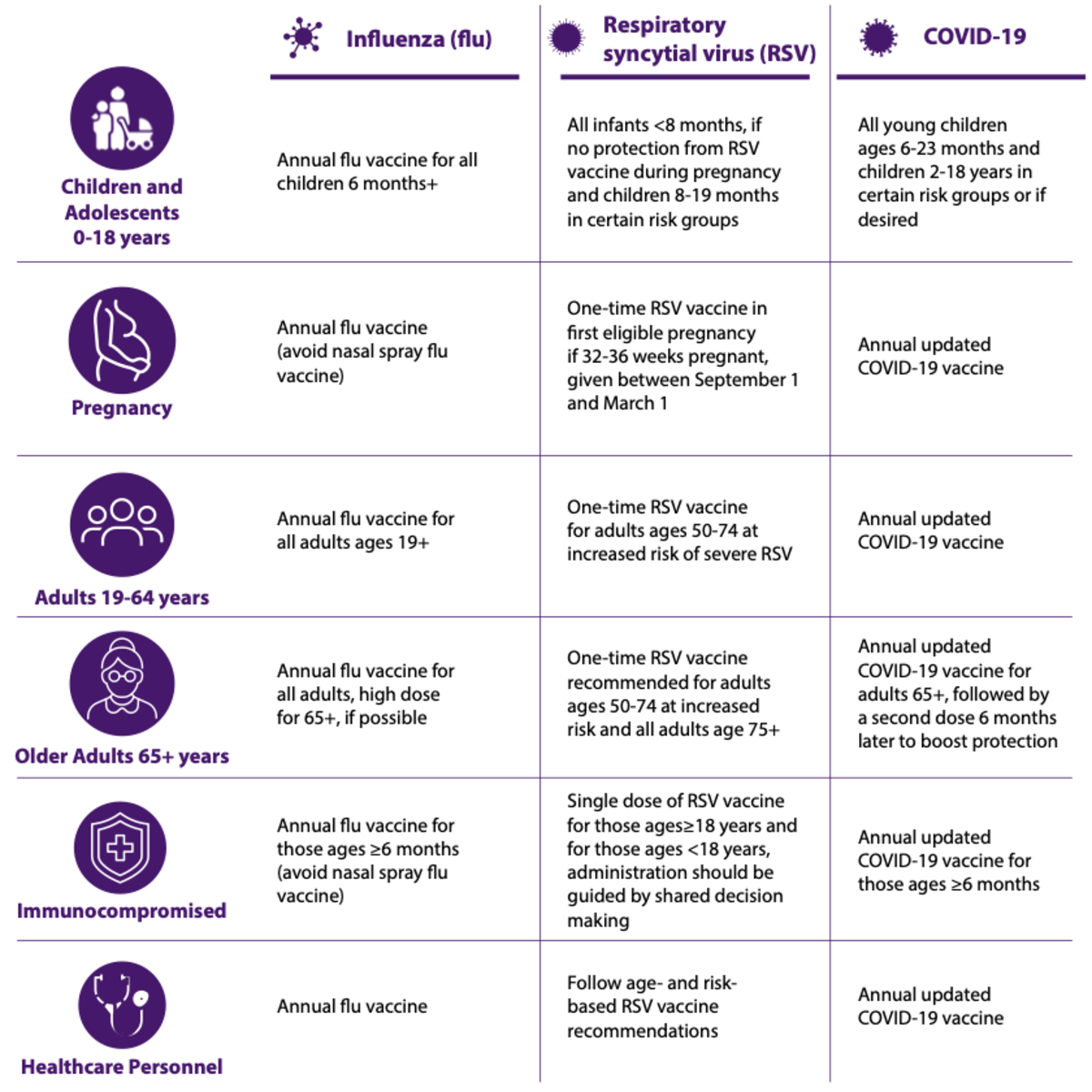
- Annual flu and Covid recommendations remain broadly consistent across populations, as do RSV recommendations for pregnant people, infants, and older adults.
- The most notable update is an expansion of RSV protection for people at increased risk—including additional groups of high-risk children entering their second RSV season and immunocompromised adolescents and adults.
- ACOG also extended the seasonal window for RSV vaccination during pregnancy through March 1, one month later than last season, reflecting recent RSV seasons that have started later and lasted longer.
- See the graphic below for a full breakdown of guidance across groups.
- The coordinated guidance also gives clinicians and patients a clear reference point ahead of respiratory season at a time when the federal vaccine recommendation process remains unsettled.
- The Centers for Disease Control and Prevention (CDC) has not issued updated recommendations for seasonal Covid or RSV immunization but has confirmed that last year’s flu vaccination guidance remains in place.
- Notably, the agency also confirmed that flu, Covid, and RSV immunizations will continue to be available through the Vaccines for Children (VFC) program, which provides vaccines at no cost to children whose families may not be able to afford them.
- Experts emphasized that patients should continue to have access to recommendations grounded in the latest scientific evidence, regardless of changes to the federal policy process.
2026-2027 Respiratory Virus Immunization Recommendations
Source: AMA
FDA Permanently Fills Key Drug and Vaccine Leadership Roles
- The Administration permanently appointed leaders to several key Food and Drug Administration (FDA) positions Tuesday (Sep. 8), including the centers responsible for regulating drugs and vaccines, after months of leadership turnover at the agency.
- Michael Davis, a psychiatrist who had been serving as Acting Director of the Center for Drug Evaluation and Research (CDER) since May, will remain in the position permanently.
- CDER oversees the approval and safety monitoring of prescription and over-the-counter drugs.
- Karim Mikhail, a pharmacist and former pharmaceutical executive who had been serving as Acting Director of the Center for Biologics Evaluation and Research (CBER), was also permanently appointed.
- CBER oversees vaccines, blood products, and cell and gene therapies, making Mikhail one of the FDA’s most influential officials on vaccine regulation and safety.
- Mikhail joined the FDA in 2025 after more than two decades in the pharmaceutical industry, including at Merck, and became Acting CBER Director in May following a series of leadership changes at the center. Since taking over, he has emphasized stabilizing CBER following a period of significant disruption.
- The permanent appointments provide greater leadership continuity at an agency that has experienced significant turnover over the past year, particularly within CDER and CBER, as the Administration continues to reshape federal drug and vaccine policy.
NIH-DoD Agreement Could Shift Billions in Funding Amid Broader NIAID Changes
- The National Institutes of Health (NIH) and the Department of Defense (DoD) have signed a 10-year agreement that could redirect a significant share of federal infectious disease research funding toward military biodefense and pandemic preparedness programs.
- Under the agreement, NIH’s National Institute of Allergy and Infectious Diseases (NIAID) could transfer funding to DoD for projects involving vaccines, treatments, and other medical countermeasures for pandemic flu, emerging infectious diseases, and chemical, biological, radiological, and nuclear threats.
- The agreement does not specify a total amount, but reporting indicates it could involve as much as $2 billion from NIAID. NIH is currently identifying projects worth hundreds of millions of dollars that could be supported through the arrangement. No funds are expected to move during the current fiscal year.
- The agreement has raised concerns among some lawmakers and research advocates that funding Congress specifically appropriated to NIH could be redirected toward DoD priorities without additional congressional approval.
- House and Senate Democrats on appropriations committees have called for the agreement to be terminated or more fully explained, arguing that Congress already funds separate DoD programs for chemical, biological, and nuclear countermeasure research and that NIH appropriations should remain focused on biomedical research.
- The agreement comes amid broader changes at NIAID, where the Administration has reduced emphasis on some pandemic preparedness and emerging pathogen research and made significant leadership changes.
- NIAID is also proposing a reorganization that would eliminate its Division of Clinical Research (DCR) and redistribute clinical research functions across other parts of the institute.
- IDSA and the HIV Medicine Association have raised concerns that the restructuring could disrupt ongoing clinical research and long-standing infectious disease research networks. Public comments on the proposal will be accepted September 14–18.
- Taken together, the funding agreement and proposed reorganization could reshape how federal infectious disease, vaccine, and pandemic preparedness research is funded and managed, though the scope of both changes remains uncertain.
CDC Reorganizes Immunization and Respiratory Disease Center
- The CDC has reorganized its National Center for Immunization and Respiratory Diseases (NCIRD), consolidating offices and restructuring several divisions and branches. According to the Federal Register notice published September 9, the changes became effective on September 4.
- The most notable change merges the CDC’s Influenza Division with its Coronavirus and Other Respiratory Viruses Division to create a new Influenza and Respiratory Viruses Division (IRVD).
- The new IRVD includes branches focused on laboratory surveillance, respiratory virus detection and immunology, surveillance and modeling, public health interventions, and emerging respiratory threats.
- According to the CDC, the reorganized division will continue to monitor respiratory viruses, support state and local outbreak response, characterize emerging viruses, evaluate vaccines and treatments, and contribute to pandemic preparedness.
- Its responsibilities also include supporting vaccine-virus selection and developing candidate vaccines for seasonal and potential pandemic respiratory viruses.
- The Federal Register notice does not explain the rationale for the reorganization or whether it will affect staffing, funding, or specific programs.
Measles Death Confirmed in Pennsylvania as Outbreak Continues
- A 6-week-old infant in Lancaster County died from measles last month, marking Pennsylvania’s first confirmed measles death in more than three decades amid the state’s largest outbreak in years. Lancaster County Coroner Dr. Stephen Diamantoni confirmed (Sep. 4) that the infant contracted measles and that the infection caused the child’s death.
- The infant, who died August 18, had a rare genetic condition that increased the risk of severe respiratory illness. The coroner said measles caused respiratory complications and low oxygen levels that contributed directly to the death.
- Pennsylvania health officials had previously announced (Aug. 25) two measles-associated deaths among unvaccinated Lancaster County residents.
- In the second case, an infant who tested positive for measles died shortly after birth, but the county pathologist determined that a spleen laceration—not measles—was the primary cause of death.
- Pennsylvania officials have said both deaths were included in the state’s earlier count of “measles-associated” deaths, a classification that can include deaths in which measles was present but was not necessarily the immediate cause.
- The deaths prompted an unusual dispute between Pennsylvania and federal health officials.
- The CDC initially did not include the Pennsylvania deaths in its national measles tally while it reviewed the cases, despite the state saying it had submitted the necessary information.
- Health and Human Services (HHS) Secretary Robert F. Kennedy Jr. publicly questioned whether the deaths were caused by measles, before acknowledging that at least one death was caused by the disease, following the coroner’s findings.
- Former public health officials have described the CDC’s independent review as unusual, noting that the agency has historically relied on state health departments to investigate and report measles cases and deaths.
- On Friday (Sep. 4), the CDC said that it is re-evaluating how measles deaths are classified to promote more consistent reporting across jurisdictions, though the agency did not provide details on why the review was initiated.
- Pennsylvania has reported 624 total cases as of September 9. Statewide measles, mumps, and rubella (MMR) coverage among kindergartners has fallen below the approximately 95% level needed to prevent sustained measles transmission. In Lancaster County, just 87.6% of kindergartners received at least two MMR doses in the 2025–2026 school year, the sixth-lowest rate among Pennsylvania’s 67 counties.
- The outbreak reflects a broader national resurgence, with more than 3,200 measles cases reported in the U.S. this year—the highest annual total in more than three decades.
- The vast majority of cases nationally have occurred among people who are unvaccinated or whose vaccination status is unknown.
- The confirmed death underscores that measles can cause severe illness and death, particularly among infants and others who are especially vulnerable, and that maintaining high MMR vaccination coverage is critical to limiting community spread.
STATE POLICY
Pennsylvania Proposes Broad Disease-Control Overhaul with Immunization Reporting Changes
- As the measles outbreak continues, Pennsylvania is considering a sweeping update to its communicable- and noncommunicable-disease regulations that would expand disease reporting requirements, strengthen immunization reporting, and revise how the state sets certain childhood immunization requirements.
- The proposed rules would require more healthcare providers to report administered immunizations to the state and expand the number of reportable diseases, infections, and conditions from 63 to 116.
- The proposal would also change how Pennsylvania sets immunization requirements for children in group childcare settings. Rather than continuing to incorporate recommendations from the Advisory Committee on Immunization Practices (ACIP), the state would write specific requirements into regulation that generally align with the AAPs’ recommended childhood immunization schedule.
- The broader overhaul would also expand the circumstances in which the Pennsylvania Department of Health may use disease-control measures for the prevention, containment, or mitigation of disease. State officials say the regulations, which have not been comprehensively updated since 2001, need to reflect current public health practice and medical guidance.
- Republican lawmakers have raised concerns that the proposal could give the state broader disease-control authority than they consider appropriate and are seeking additional legislative oversight of future regulations.
- The proposal is not final. Public comment remains open through September 21, and the Independent Regulatory Review Commission has not yet acted on the rule.
Arizona, Colorado, and Oregon Preserve Broad Access to Updated Vaccines
- This week, Arizona, Colorado, and Oregon health officials issued statewide standing orders to preserve broad access to updated 2026–2027 vaccines through pharmacies and other vaccine providers.
- In Arizona, the Department of Health Services issued standing orders for both Covid and flu vaccines, allowing pharmacists and other authorized providers to administer the vaccines without an individual prescription.
- The orders were issued amid uncertainty around the timing of the next ACIP meeting and are intended to ensure continued access to FDA-approved vaccines for people who choose to receive them.
- In Colorado, health officials renewed a statewide standing order allowing anyone ages 6 months and older to receive an updated Covid vaccine without an individual prescription, extending a similar policy put in place last year.
- Earlier this year, Colorado also enacted legislation giving pharmacists independent authority to prescribe vaccines and allowing state vaccine policy to draw on recommendations from medical organizations in addition to federal guidance.
- Both moves are intended to align the state with guidance from medical societies including AAP and AAFP.
- In Oregon, the statewide standing order allows authorized health practitioners to administer updated Covid vaccines without requiring an individual prescription.
- The order covers groups at higher risk of severe illness—including young children, adults 65 and older, pregnant individuals, people with underlying conditions, and healthcare workers—but also allows for vaccination of all people who so choose.
- The action was issued under authority created by a law enacted earlier this year that allows Oregon’s Public Health Officer to issue standing orders for drugs used to prevent or control disease.
- The move aligns the state with updated recommendations from the West Coast Health Alliance (WCHA), which recently issued 2026-2027 guidance informed by leading medical societies.
New Hampshire Expands Pharmacist Vaccination Authority
- A new law that took effect Monday (Sep. 8) expands pharmacists’ authority to administer vaccines in New Hampshire and reduces the state’s reliance on federal immunization recommendations.
- Previously, pharmacists could administer FDA-licensed vaccines to adults if they were recommended by ACIP.
- Under the new law, pharmacists may administer any FDA-licensed vaccine to adults ages 18 and older under an immunizing pharmacist’s order, regardless of whether ACIP has recommended it.
- The change could help preserve access to vaccines if federal recommendations are delayed, narrowed, or otherwise changed, and reflects a broader trend of states taking steps to reduce their dependence on federal vaccine guidance.
OUTBREAK OUTLOOK
Measles Cases Continue to Surge Across the U.S. and Internationally
- As of September 8, the U.S. has reported 3,231 measles cases in 2026—an increase of 183 cases since last week.
- Pennsylvania and Wisconsin continue to drive the increase in cases:
- Pennsylvania reached 624 measles cases as of September 9—an increase of 91 cases in the last seven days—with 109 hospitalizations and two measles-associated deaths.
- Wisconsin reached 159 total cases as of September 8. The vast majority of cases (151 confirmed and 6 probable) have been part of the Southwestern outbreak, which has increased by 49 cases since last week’s newsletter.
- Several other states have reported new or continued measles activity in the last week:
- Illinois has reported 11 measles cases as of September 8—up five cases since last week. Illinois state health officials have declared a measles outbreak in Douglas County after identifying at least four linked cases.
- Kentucky’s outbreak has grown to 45 confirmed cases and three hospitalizations as of September 10—up seven cases from last week. All cases are among individuals who are unvaccinated or whose vaccination status is unknown.
- New York has recorded 51 cases this year—an increase of ten since last week. This includes six cases in New York City and 45 in the rest of the state.
- Ohio has recorded 129 cases as of September 8, an increase of seven cases from last week.
- Oregon has reported 57 cases this year as of September 9—up three from last week.
- Other countries are facing even more severe outbreaks. In Bangladesh, which has experienced significant vaccine shortages and coverage gaps, suspected measles cases have surpassed 166,000 and the death toll has nearly reached 1,000 this year.
Ebola Outbreak Continues to Grow as Clinical Trials Begin for a Vaccine Candidate
- The Bundibugyo Ebola virus outbreak in the Democratic Republic of the Congo (DRC) continues to outpace response efforts, with over 6,843 confirmed cases and 3,310 related deaths through September 7—an increase of 657 cases and 303 deaths since last week’s newsletter.
- The World Health Organization (WHO) said another 5,000 health workers and 1,600 treatment beds are needed as the outbreak spreads geographically and threatens to reach larger cities.
- University Hospital Southampton (UHS) joined University of Oxford researchers in the world’s first clinical trials of their Bundibugyo ebola virus vaccine candidate.
- UHS will house clinical trials for the ChAdOx1 Ebola BDBV vaccine, including 50 healthy volunteers aged between 18 and 55.
- This vaccine applies the same technology used to create the Oxford-AstraZeneca Covid vaccine, which is estimated to have saved over six million lives during its first year of use.
WHAT TO WATCH
Confirmation Hearings Scheduled for HHS Deputy Secretary and Surgeon General Nominees (Sep. 15-16)
- Chris Klomp and Dr. Nicole Saphier—Trump’s nominees to serve as Deputy Secretary of HHS and Surgeon General, respectively—are expected to appear before the Senate Health, Education, Labor, and Pensions (HELP) Committee in a confirmation hearing next week (Sep. 16). Klomp is also expected to appear before the Senate Finance Committee the day prior.
- Klomp has already become one of Kennedy’s most influential aides since being promoted to Chief Counselor in February and has overseen personnel decisions including the nomination of Dr. Erica Schwartz to lead the CDC. If confirmed, he would serve as Kennedy’s second-in-command.
- Saphier, a radiologist and Fox News contributor, is Trump’s third nominee for Surgeon General following the withdrawal of Dr. Janette Nesheiwat and the failed nomination of Dr. Casey Means.
- Senators’ questions may focus on the nominees’ approaches to HHS leadership, federal vaccine policy, and the department’s broader public health agenda, particularly as the Administration continues to navigate ongoing scrutiny over CDC leadership, ACIP, and changes to vaccine recommendations.
State Challenge to Federal Vaccine Policy Changes Moves Forward
- On Tuesday (Sep. 8), a federal judge ruled on the Administration’s motion to dismiss, allowing key portions of a lawsuit brought by a coalition of states challenging federal vaccine policy changes to move forward.
- The lawsuit alleges that HHS and the CDC violated federal law when they changed the recommended childhood immunization schedule, reconstituted ACIP, and eliminated the universal hepatitis B birth dose recommendation.
- District Judge Vince Chhabria granted the Administration’s motion in part, allowing key portions of the states’ challenge to continue.
- The court allowed the states’ challenge to the CDC’s schedule changes to continue, citing potential harms including lower vaccination rates following the shift of several vaccines from universal recommendation to shared clinical decision-making (SCDM), increased outbreak risk, higher state health care costs, and additional administrative burdens.
- The court dismissed the states’ claims related to ACIP recommendations and ACIP appointments but gave the plaintiffs 21 days to amend those portions of the complaint.
- The decision does not yet decide whether the federal vaccine policy changes were unlawful.
U.S. Chamber Urges Evidence-Based Review of Vaccine Policy Changes
- The U.S. Chamber of Commerce sent a letter to Kennedy last week (Sep. 2) urging the Administration to ensure any next steps tied to the recent Executive Order on childhood vaccines are grounded in evidence-based science and preserve vaccine access and coverage.
- The letter emphasizes that major changes to federal vaccine recommendations could affect public health, insurance coverage, vaccine development, manufacturing, supply chains, and patient access.
- The Chamber specifically raised concerns about any effort to separate the MMR vaccine into individual components or increase spacing between childhood immunizations, noting that there are currently no single-antigen MMR products approved in the U.S. and that developing such products could require new investment, clinical trials, regulatory review, manufacturing changes, and distribution adjustments.
- The letter encourages HHS to rely on longstanding review processes, including ACIP’s Evidence to Recommendations and Grading of Recommendations Assessment, Development, and Evaluation (GRADE) approaches, and to engage immunization experts, physicians, researchers, employers, manufacturers, insurers, and other stakeholders before moving forward with changes that could have unintended effects on vaccine access, coverage, and public confidence.
VRBPAC to Consider 2027 Southern Hemisphere Flu Vaccine Strains (Oct. 1)
- The FDA’s Vaccines and Related Biological Products Advisory Committee (VRBPAC) is set to meet October 1 to consider flu vaccine composition for the 2027 Southern Hemisphere season.
- The committee will review global surveillance, virus characterization, and vaccine-response data to advise the FDA on which flu strains should be included in vaccines—a process designed to give manufacturers several months to produce and distribute updated doses.
- The FDA reviews Southern Hemisphere vaccine composition as part of the global flu surveillance process, which can provide an early indication of strains that may become important during the following Northern Hemisphere season.
- The meeting follows the WHO’s September 21–24 consultation to recommend strains for the 2027 Southern Hemisphere season.
###
Vaccinate Your Family is a nonpartisan organization dedicated to protecting people of all ages from vaccine-preventable diseases. To learn more, visit us at: vaccinateyourfamily.org
If additional members of your team would benefit from receiving this newsletter, please reply to this email with their information so they can be added to the newsletter distribution list.